

TL;DR: How a 25-year-old ex-OpenAI researcher turned a 439% AI trading run into a forced fire sale to Citadel - and why a hidden Anthropic stake became the last thing standing between Situational Awareness and a full-blown implosion.
Let’s jump in!
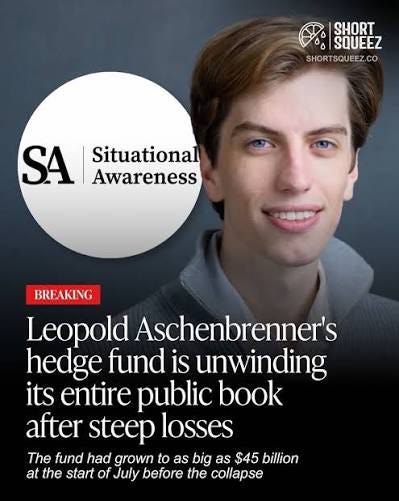
Situational Awareness: How a 439% Gain Ended in a Forced Sale to Citadel
All credits belong to Short Squeeze
For most hedge funds, a 439% return in six months would be the defining achievement of a lifetime. For Situational Awareness, it became the prelude to a crisis.
The AI-focused fund founded by former OpenAI researcher Leopold Aschenbrenner entered July 2026 as one of Wall Street’s most closely watched new firms. It had more than $20bn under management, a concentrated portfolio built around the physical infrastructure required for advanced AI, and an investment thesis that had worked spectacularly well.
Within weeks, that same portfolio was under severe pressure. Falling hardware stocks weakened the collateral behind the fund’s borrowing, while rising software shares hurt its short positions. Lenders demanded more cash. Situational Awareness did not have enough readily available liquidity to satisfy them without selling assets, and Citadel ultimately acquired a large part of its public-equity book.
The speed of the reversal made the story irresistible. A young founder had translated a sweeping forecast about artificial intelligence into one of the most profitable trades on Wall Street, only to discover that a sound long-term thesis cannot rescue an overextended portfolio from a short-term liquidity crisis.
1. From AI manifesto to hedge fund
Aschenbrenner first attracted broad attention in June 2024, when he published Situational Awareness: The Decade Ahead. The 165-page essay argued that continued progress in computing, algorithms, and hardware could produce artificial general intelligence (AGI) by around 2027. From there, he expected an “intelligence explosion” with consequences far beyond the technology industry, including enormous changes in energy demand, national security, and capital markets.
He did not leave the thesis on paper. Later that year, he launched Situational Awareness LP with about $225m in initial capital. The backers included several prominent figures from technology and finance: Stripe co-founders Patrick and John Collison, former GitHub chief executive Nat Friedman, investor Daniel Gross, and quantitative trading firm Jane Street.
The fund grew at a pace rarely seen in the hedge-fund industry. By the middle of 2026, it reportedly managed more than $20bn of investor capital. Borrowing expanded its gross market exposure much further, with some accounts placing the total book near $45bn.
Its first-half performance explained much of the excitement. Situational Awareness returned 439% after fees through June, according to an investor letter reviewed by the Financial Times. Since inception, the gain was even larger. All of this came from a remarkably small operation. The firm had only a handful of employees, and Aschenbrenner had no conventional money-management record before launching it.
That lack of experience had looked almost beside the point while the portfolio was rising. By the end of July, it looked much more important.
2. The trade behind the returns
Situational Awareness was built around a simple observation: however sophisticated AI software becomes, it still depends on physical systems. Frontier models need memory chips, high-performance servers, data centres, cooling equipment, and vast amounts of electricity. If AI development continued at the pace Aschenbrenner expected, spending on that infrastructure would have to rise sharply for years.
The fund expressed this view through large positions in companies across the AI supply chain. Public filings and subsequent reporting linked it to memory producers such as Micron Technology and SK Hynix, cloud-computing providers including Nebius Group, and CoreWeave, storage specialist SanDisk, and server maker Super Micro Computer. It also invested in power and data-centre businesses positioned to benefit from rising electricity demand.
The other side of the strategy was less obvious. Situational Awareness also bet against established software companies, most notably Adobe. The reasoning was that autonomous AI agents would weaken parts of the traditional software-as-a-service model. If customers could use generative tools to produce designs, write code or automate workflows, some familiar subscription products might lose pricing power.
This combination was often abbreviated to “long chips, short software.”
For much of the first half of 2026, both sides worked. Investors poured money into AI hardware and infrastructure, while parts of the software sector struggled. The fund then used leverage to turn strong market moves into extraordinary returns.
Leverage was the accelerator. It was also the structural weakness.
3. Why leverage changes the outcome
A leveraged investor uses borrowed money to control a portfolio larger than the capital supplied by clients. Hedge funds typically arrange that financing through prime brokers, the divisions of large investment banks that provide loans, trading services, and custody.
Consider a simplified example. A fund begins with $100 of its own capital and borrows another $400, giving it a $500 portfolio. If the assets rise by 10%, the portfolio becomes worth $550. After repaying the $400 loan, the fund is left with $150. A modest move in the underlying investments has produced a 50% gain on the original capital.
The arithmetic is just as powerful in reverse. A 10% decline reduces the same portfolio to $450. Once the loan is accounted for, only $50 remains. A 20% fall eliminates the fund’s starting capital entirely.
Prime brokers do not wait until the equity reaches zero. They require the borrower to maintain a minimum level of collateral and can issue a margin call when that cushion becomes too thin. The fund must then provide cash, contribute additional collateral or reduce its positions. If it cannot act quickly enough, the lender can force a sale.
This creates a problem that has little to do with whether the original investment idea is eventually proved right. A leveraged portfolio must survive every move along the way. When several correlated positions fall together, the need to raise cash can arrive precisely when selling is most expensive.
That is what happened to Situational Awareness.
4. The portfolio was squeezed from both sides
The immediate pressure came from a sharp sell-off in AI-related shares during July. Several of the fund’s important long positions fell heavily from their peaks. Nebius lost nearly half its value at one stage, while SanDisk, CoreWeave, and major memory-chip producers were also caught in the decline.
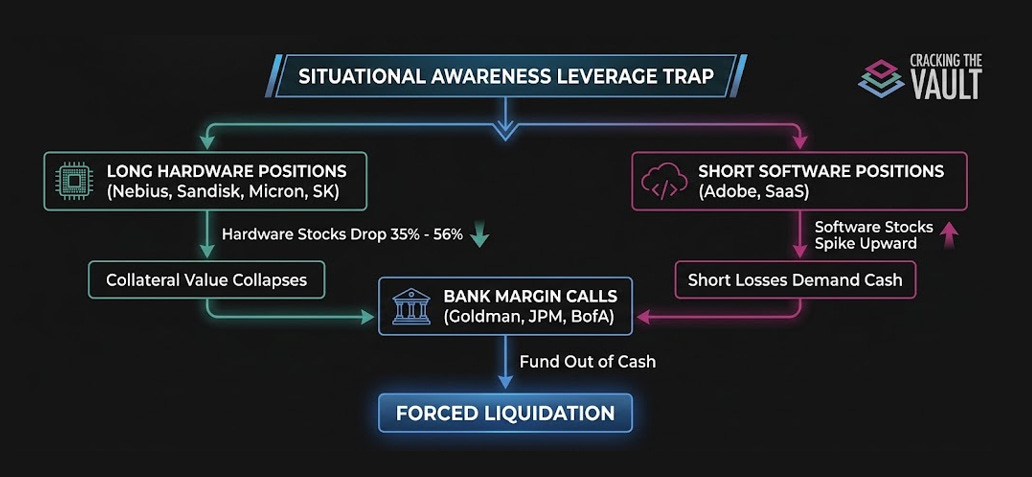
Each fall did more than create an investment loss. It reduced the value of the collateral supporting the fund’s loans. That allowed the prime brokers to demand additional protection.
At the same time, some of the fund’s software shorts moved in the opposite direction. A rising share price is a loss for a short seller, and the position may require extra collateral as it moves against the investor. Situational Awareness therefore faced a double squeeze: its long book was losing value while its short book was consuming more cash.
The portfolio may have been diversified across different companies, but it was not diversified across different economic outcomes. Most positions depended on the same broad view of the AI trade. Once that view reversed in the market, correlations rose and several losses arrived together.
Goldman Sachs, JPMorgan Chase, and other lenders were reported to have pressed the fund for more capital. Situational Awareness attempted to raise money and explored asset sales, but much of its capital remained tied up in the positions already under pressure. The firm needed liquidity quickly, not confidence in where the stocks might trade six months later.
5. Four days from buying opportunity to portfolio sale
The crisis unfolded with unusual speed.
On July 24, Aschenbrenner wrote to investors about the damage from the technology sell-off. He remained publicly committed to the thesis, describing the decline as one of the most attractive opportunities since early 2025. Investors were invited to add money at the start of August.
Over the next several sessions, however, the selling intensified. Losses in positions such as Nebius and SanDisk increased the pressure from lenders. What had been presented as an opportunity to buy more became an urgent search for capital.
By July 29, Situational Awareness was holding talks with potential investors and buyers. Selling a portfolio of that size stock by stock could have pushed prices down even further, worsening the fund’s losses and leaving its prime brokers with a disorderly unwind.
The cleaner solution was a block transaction with a large institutional buyer. Millennium Management and Jane Street were among the firms reported to have considered the assets. Citadel, the investment firm founded by Ken Griffin, ultimately secured the deal.
Reports differ on the exact scope of the transaction. The Wall Street Journal described Citadel as acquiring the bulk of the stock portfolio, while the Financial Times reported that it bought a substantial portion of roughly $16bn in public-equity holdings. Axios reported that the entire public-equities portfolio changed hands. What is clear is that Citadel absorbed a very large part of the book in a privately negotiated sale, avoiding the need for Situational Awareness to dump the positions into the open market.
The transaction covered public securities rather than the whole firm. Situational Awareness retained private investments, including a stake in Anthropic estimated at about $5bn. Anthropic had raised $65bn at a $965bn post-money valuation in May 2026, making that holding potentially the fund’s most valuable remaining asset.
The personal connection also drew attention. Aschenbrenner’s fiancée, Avital Balwit, is chief of staff to Anthropic chief executive Dario Amodei. That relationship does not explain the economics of the investment, but it reinforced the sense that the fund’s future had become closely tied to one private AI company.
Rather than disappearing, Situational Awareness may now resemble a private investment vehicle centred on Anthropic and its remaining unlisted holdings.
6. Rumours, jokes and the rebound
The collapse became instant material for financial social media. Comparisons with Archegos Capital appeared almost immediately, largely because both episodes involved concentrated positions, bank financing, and an abrupt loss of control once lenders demanded more collateral. Others compared the episode with Three Arrows Capital.
The fund’s name supplied an obvious punchline. Commentators joked that a firm called Situational Awareness had failed to maintain awareness of its own liquidity position. References to Aschenbrenner’s earlier work at the FTX Future Fund added another layer to the online criticism.
The serious reporting was soon mixed with claims that had little or no supporting evidence. Some accounts suggested that institutional investors had deliberately encouraged expectations of Federal Reserve rate increases to push down technology shares and create a cheap buying opportunity. Others claimed former Binance chief executive Changpeng Zhao was preparing to provide emergency capital.
No credible evidence emerged for either theory. The reported transaction was with Citadel, not Zhao or an offshore crypto vehicle. The rumours were a useful reminder that forced liquidations create an information vacuum: traders can see unusual price movements before they know who must sell or why.
Then came the most painful part for Situational Awareness. Once the block sale removed the threat of continued forced selling, many of the same AI-linked shares rebounded sharply. On July 30, Bloom Energy, Nebius, IREN, SanDisk, and CoreWeave all posted large gains, while AMD also rallied. The precise moves changed through the session, but the pattern was clear.
The market was no longer pricing the risk that a distressed holder might unload billions of dollars of stock.
For Situational Awareness, this was a classic bottom-tick outcome. Its thesis about AI infrastructure had not suddenly been disproved. The fund had simply lost the ability to wait. Citadel, with deeper liquidity and no immediate need to sell, could take the other side.
7. What the episode actually shows
The easy conclusion is that Aschenbrenner was wrong but that is not quite the lesson.
His broad argument that AI development would require massive investment in chips, data centres and electricity has held up well. The failure occurred in the translation from idea to portfolio. Situational Awareness combined a concentrated thematic bet with heavy borrowing and too little liquid capital to absorb a violent reversal.
Three points stand out:
First, being right about direction is not enough. Timing, position size, and financing determine whether an investor can stay in the trade long enough to benefit. A portfolio that cannot survive a 30% drawdown does not truly own a five-year thesis.
Second, liquidity has value precisely when markets are stressed. Situational Awareness had attractive assets but needed cash immediately. Citadel had cash and could negotiate from strength. The difference between the forced seller and the opportunistic buyer was not necessarily insight. It was the freedom to wait.
Third, private assets can preserve value while public positions are being marked down in real time. The retained Anthropic stake gives Situational Awareness a possible second life, but it also leaves the firm dependent on a concentrated and illiquid holding. That may prove enormously valuable. It is not the same as having cash.
The episode belongs to a familiar Wall Street tradition. Long-Term Capital Management, Archegos, and other leveraged funds did not fail because every idea in their portfolios was foolish. They failed because lenders, collateral rules, and market timing took control of the decision-making.
Situational Awareness reached the same point in July 2026. Its founder may still be right about the scale of the AI infrastructure boom. Citadel bought the time required to find out.
Until next time, stay curious!
Advertise with us // Contact us // X/Twitter // Instagram